

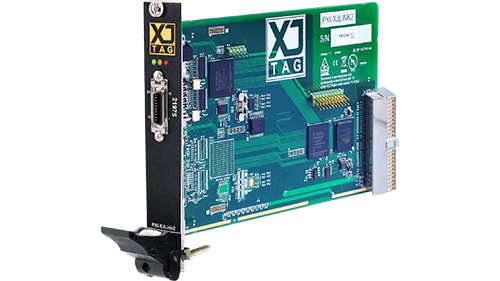
PXI-XJLink2 allows the integration of XJTAG into PXI-based test systems. PXI-XJLink2 is an XJLink2 JTAG controller on a PXI (CompactPCI®) card, that can be connected to up to 4 JTAG chains, and is configurable for pin-out and voltage. It is easily integrated with LabVIEWTM with a full set of Virtual Instruments (VIs) included.
Key Benefits
Standard PXI interface
Ideal for lab and production work
Self-contained licence
So you can run XJTAG from a standalone PXI rack
Reconfigurable I/O pin-out
Allows reuse across multiple projects
Easy integration
With NI’s LabVIEW™ and TestStand™*
Full compatibility
With other XJLink2 controllers
Features
- 32 bit PXI/cPCI bus interface
- NI LabVIEW Virtual Instruments (VIs) available (National Instruments)
- 3U form factor
- Connects to up to 4 JTAG chains on the UUT
- Configurable functionality for all I/O pins
- TCK clock frequencies up to 166 MHz
- Two different voltages can be configured, from 1.1 V to 3.3 V in 0.1 V steps
- Visual indication of test status
- Adjustable signal slew rate and drive strength
- Automatic signal skew control
- Built in voltage meter on all I/O pins. Voltage input: Min 0 V, Max 5 V
- Frequency counter on all I/O pins. Frequency input: Min 1 Hz, Max 200 MHz.
Selectable measurement period of 1 ms, 10 ms, 50 ms, 100 ms, 500 ms, 1 s, 5 s, 10 s. - JTAG signals are +5 V tolerant
- Spare pins on the JTAG connector can be used to indicate the test status or to control other items — e.g. hold a board in reset / turn on a PSU
- Pins can also be used as general purpose I/O during testing, for example for fast Flash programming
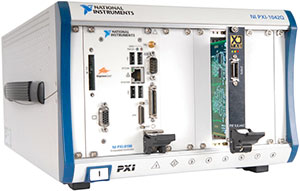
PXI/cPCI solution
PXI-XJLink2 provides a JTAG solution that can be integrated with other test equipment using the industrial PXI standard designed to minimise the effect of electrical noise. It is CompactPCI® compatible so can be used in any cPCI or PXI-based test system.
CompactPCI® is a registered trademark of the PCI Industrial Computers Manufacturers Group. LabVIEW and LabWindows are registered trademarks of National Instruments. All other trademarks are the property of their respective owners.
Configurable JTAG interface
The 20-way connector is configurable to match the connector pin-out on the PCB, allowing cabling to be kept simple and simplifying the process of connecting your XJTAG test system to the Unit Under Test.
PXI-XJLink2 has both configurable voltage domains and variable signal termination, so it can handle any JTAG TAP even if the signals are not well terminated. The advanced auto-skew control enables you to get the maximum frequency out of your JTAG chain and cable.
Flexible & scalable
From a single port system for development, to multiport test and programming systems in production, the PXI-XJLink2 module provides a flexible, scalable JTAG solution.
With self-contained licences, XJTAG testing is not tied to a single PC. Alternatively, the system can be licensed from a network server allowing the maximum use of your XJTAG products without having to move licensed hardware between machines.
Integration
The standard .NET and COM interfaces allow you to integrate XJTAG testing with test executives such as NI LabVIEW™, LabWindows™/CVI, with ATE machines, or a bespoke application written in languages such as Visual Basic .NET® or C#®. XJTAG provides coding examples for LabVIEW, LabWindows, C#, C++ and Visual Basic.
*The XJTAG trademark and logo are registered trademarks of XJTAG Ltd. All Rights Reserved. CompactPCI® is a registered trademark of the PCI Industrial Computers Manufacturers Group. LabVIEW and LabWindows are registered trademarks of National Instruments. All other trademarks are the property of their respective owners.
Connectors
Example connectors to connect to the PXI front module: Manufacturer: 3M (refs. 10320-3210-000 and 10120-6000EL)