
AMD Versal™ AI Edge Series Gen 2 VEK385 Testing & Programming
XJTAG Boundary Scan Board Test & Programming Speed Reference for the VEK385 Evaluation Kit
Development & Evaluation Board Testing > VEK385 Evaluation Kit Reference
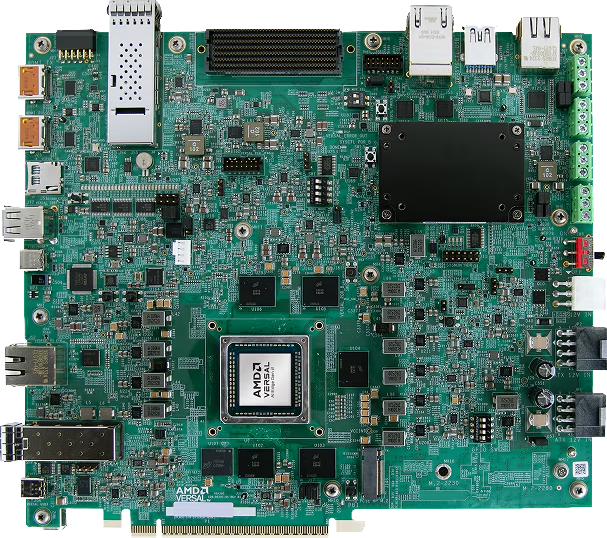
About the AMD VEK385 Evaluation Kit
The AMD VEK385 Evaluation Kit (part EK-VEK385-G) is built around the AMD Versal™ AI Edge Series Gen 2 2VE3858 adaptive SoC, which combines AI inference acceleration with enhanced safety and security in a single device. It ships with a broad set of connectivity options, development tools, and reference designs intended to speed up prototyping for embedded applications with high-security, high-reliability, long-lifecycle, or safety-critical requirements. AMD positions the board for evaluation and prototyping rather than volume production, and notes it’s also suitable for Versal Prime Series Gen 2 evaluations.
See the official AMD VEK385 product page for pricing and datasheets.
- Adaptive SoC: XC2VE3858-2MSESSVA2112 (Versal AI Edge Series Gen 2)
- Configuration flash: MT35XU02GCBA1G12-0AAT (2 Gbit /256 MByte)
- Onboard peripherals: LPDDR5, Ethernet PHYs, USB hub, CAN transceivers, power telemetry & voltage regulation
Prototyping on this board with XJTAG allows for immediate isolation of assembly issues and lets you reuse the same boundary scan test scripts when you move to your own custom hardware.
AMD VEK385 Flash Programming Speed
Fast programming is a real productivity benefit when developing and debugging firmware. XJFlash in the supplied project can program your application at speeds only limited by the flash on the board.
XJFlash High-Speed Programming Benchmarks
XJFlash programs the VEK385’s full 2 Gbit MT35XU02GCBA1G12-0AAT flash in 184 seconds.
| XJFlash Operational Metric | 2 Gbit (full flash size) | 32 Mbit (example application) |
|---|---|---|
| Erase Time* (Unprogrammed) | 6.6 s | 0.1 s |
| Programming Cycle Time | 184 s | 2.8 s |
| Verification Cycle Time | 23 s | 0.4 s |
| Total Erase/Program/Verify** | 216 s | 5.9 s |
*Fully programmed devices will take longer to erase. Sampled examples: 341 s for the full 2 Gbit / 5.6 s for 32 Mbit.
**Including FPGA configuration
Boundary Scan Test Coverage
If your application is not behaving as expected, XJTAG testing can help identify if there has been any damage to the development board while it has been used for prototyping. The supplied tests can also be heavily reused when you move to your own custom hardware.
| Device Category & Subsystem | Designator(s) |
|---|---|
| Core Adaptive SoC | U1 |
| Slow Pull Resistors | R504, R508, R512, R516 |
| LPDDR5 Memory | U102, U103, U104, U105, U106 |
| SPI Flash | U25 |
| I2C Bus Selector | U161 |
| I2C IO Port Expanders | U37, U266 |
| I2C Switches | U162, U253 |
| EEPROM | U35, U52, U165, U166 |
| Ethernet PHYs | U112, U114, U115 |
| USB Hub | U29 |
| Frequency Translator | U49 |
| Retimers | U41, U45 |
| Clock Jitter Cleaners | U101, U164 |
| PMICs | U243, U245, U254, U255, U256 |
| Power Monitors | U64, U233, U272, U275, U276, U277, U278, U279, U280, U281, U282, U283, U284, U285, U286, U287, U288, U289, U290, U291, U292, U293, U294, U295, U296, U297 |
| Voltage Regulators | U92, U93, U94, U175, U176, U189, U190, U191, U193, U195, U196, U201, U202, U203, U204, U205, U206, U207, U219, U220, U228, U247, U248, U249 |
| Status LEDs | DS1, DS2, DS4, DS5, DS6, DS7 |
| Push Buttons | SW4, SW6, SW7 |
| CAN Transceivers | U39, U40, U119, U120 |
Get the Verified Source Files
Request the complete, pre-packaged XJTAG Test Project for this evaluation kit.