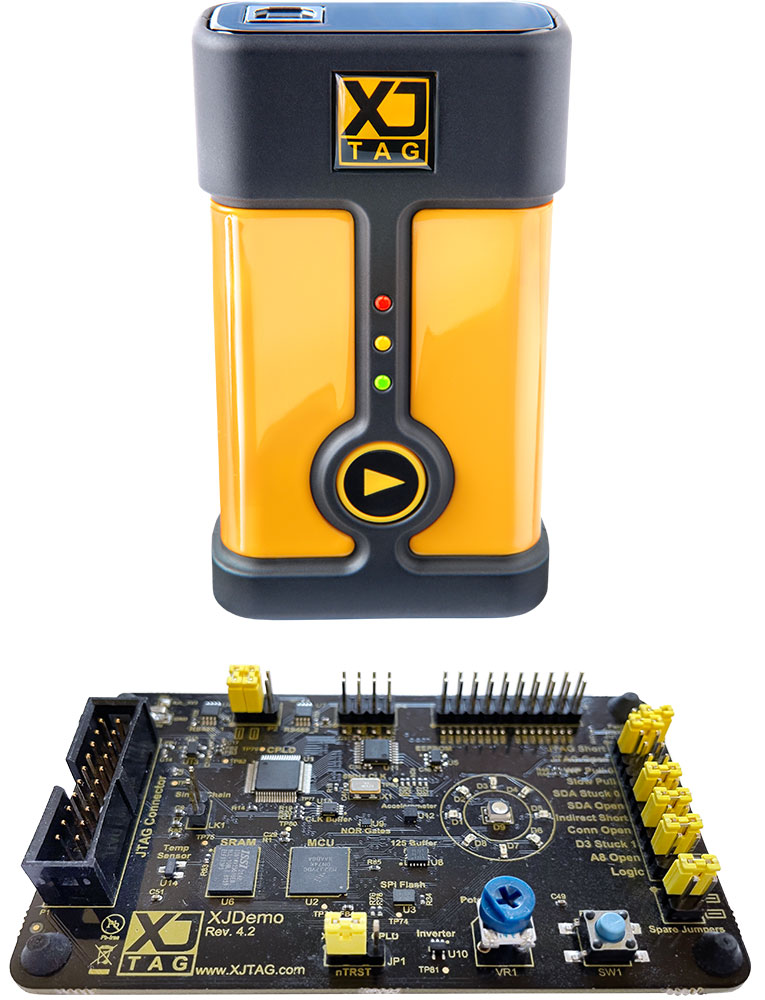
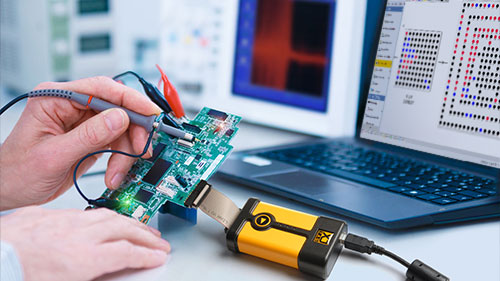
 Want to test your prototype?
XJTAG allows you to test your prototype hardware without needing firmware, making it ideal for debugging during development. This enables you to identify both design and assembly issues, as well as to maximise test coverage by highlighting areas with limitations.
XJTAG testing during R&D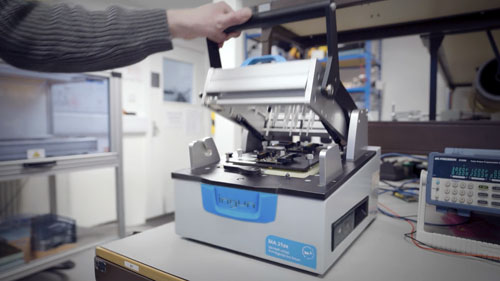 Setting up production line testing?
Fast and accurate testing offers you increased coverage even for pins hidden under BGAs and for nets without test points. XJTAG pinpoints the problem device when assembly faults are found and save time by testing multiple boards simultaneously.
XJTAG testing in Production Need high-speed flash programming?
Use an FPGA, CPLD or processor on your board to carry out accelerated flash programming as part of your test process. The acceleration can make a typical erase-program-verify process over 10 times quicker.
More about programming
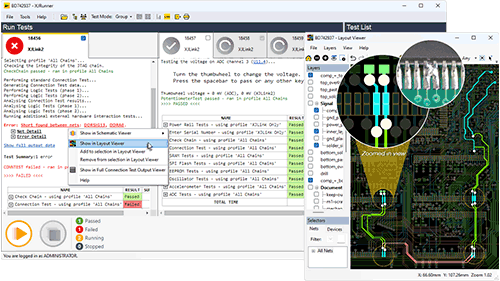 XJRunner
Diagnose and locate board faults quickly with high test coverage, fast test execution and shorter test cycles. Includes in-system programming and integrates with automated systems.
Explore XJRunner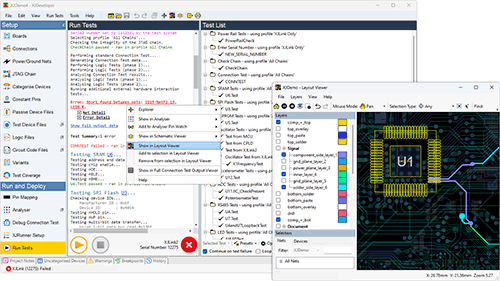 XJDeveloper
Easily create tests and set up programming for high-density electronics products with XJTAG’s integrated development environment. Debug the tests on prototype hardware ready to deploy to production.
Explore XJDeveloper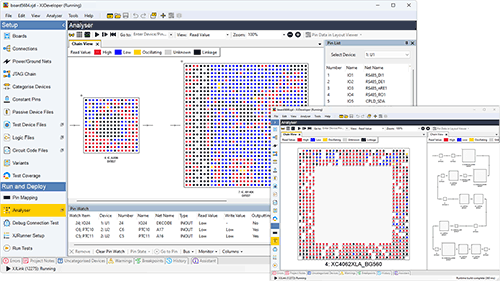 XJDeveloper Plus
Benefit from all XJDeveloper capabilities including the Analyser and Flash modules to assist in prototype bring-up and setting up of accelerated programming.
Explore XJDeveloper Plus
XJTAG has features that are vastly superior to other systems I know. The learning curve for new users is dramatically shorter.

XJTAG delivers the best combination of quality and features meeting our needs, at the right price. The viewers help visualise each board both logically and physically.
We evaluated the major boundary scan systems, and chose XJTAG for its superior features and support.

The reuse of tests on the XJTAG system is a big time saver. The design for test (DFT) reports help us ensure that a very high percentage of our circuits are testable before we go into serial production and, with the aid of boundary scan tests, we get closer to our goal of 100% test coverage on production Shop Replaceable Units (SRU).

We have cut the overall programming and test time of one of our boards from two hours to four minutes while at the same time considerably increasing test coverage. Fault diagnosis is also faster, and we are benefiting at the operational level through reduced operator training and by eliminating the need to author extended work instructions, which can take days.

XJTAG integrates well with National Instruments TestStand, our preferred environment for creating and managing tests.

After successfully locating the faulty solder joint, XJTAG testing became part of the standard bring-up procedure. It gave us easy low-level access to the FPGA’s individual pins.