Find Out How UAV and Drone Manufacturers Are Accelerating Development
 Simon Payne, CEO, XJTAG
|
Subscribe to LinkedIn newsletter

A leading aerospace technology manufacturer that delivers advanced UAV and drone systems faced growing challenges as the complexity of its next‑generation embedded electronics increased. With rising pressure to meet tighter delivery windows and performance targets, traditional testing methods were no longer fast or flexible enough. To maintain reliability and accelerate development, the engineering team adopted advanced structured testing.
The Challenge
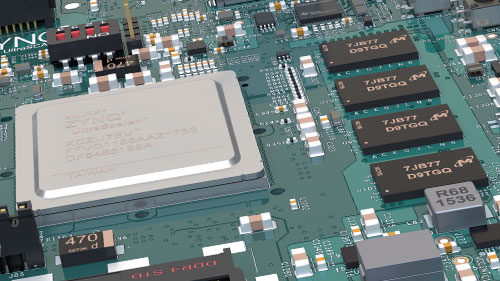
Modern UAV platforms rely on dense, multi‑layer PCBs powering mission‑critical functions such as guidance, communication, sensing, and control. These boards often include:
- High‑performance processors
- Larger FPGAs in BGA packages
- High‑speed memories and interfaces
- Fine‑pitch, tightly packed digital circuitry
Limited physical test access made it difficult to verify solder joints, interconnects, and logic behaviour, especially under BGAs and high‑density components. The team needed a faster way to validate prototypes and ensure production‑ready quality without relying on slow or labour‑intensive probing.
The Turning Point
Boundary scan testing enabled engineers to overcome test‑access and time‑to‑market challenges by providing a safe, automated way to verify assembly quality.
With this approach, the engineering team could:
- Detect shorts, opens, and interconnect faults
- Validate soldering and verify connections beneath BGAs, and on fine‑pitch devices
- Program memories and programmable logic devices quickly during development and production
- Reuse test scripts created during prototyping for production units
This capability dramatically reduced the time required to prepare UAV electronics for functional testing.
Why It Works
Advanced boundary scan testing provides a unified method for verifying digital circuitry across development, production, and field‑level validation.
Key advantages:
- High‑coverage testing even under inaccessible BGA devices
- Fast programming workflows, enabling rapid iteration during development
- Portable testing hardware, allowing engineers to validate boards in the lab, on production lines, or during field integration
- Reusable, scalable test assets, supporting multiple designs and product variants
This consistency strengthens test strategy across the full UAV electronics lifecycle.
Results
- Faster turnaround during prototype bring‑up
- Earlier identification of assembly and interconnect issues
- Improved reliability before functional or environmental testing
- Simplified production test workflows with reusable scripts
- Increased confidence during integration of UAV subsystems
Structured testing now plays a key role in helping aerospace engineering teams deliver high‑performance UAV electronics within tight project timelines.
Take the Next Step
- Discover how a aerospace and UAV manufacturer improved safety and accelerated their testing. Here is the case study.
- Book a Free Hands-on Taster Workshop Today.
Related Reading