Find Out How Boundary Scan Shortens Board Bring-Up by Weeks, Not Days
 Simon Payne, CEO, XJTAG
|
Subscribe to LinkedIn newsletter

Why Early Hardware Visibility Eliminates Guesswork and Keeps Bring-Up on Schedule
Intro
Board bring-up is where schedules quietly slip.
A custom board arrives on the bench. It doesn’t boot. Nothing obvious appears wrong. Power rails look good. Clocks are present. Yet progress stalls.
At this stage, teams often lose days, or weeks, not because the problem is complex, but because they lack clear visibility into the hardware. Boundary scan changes that dynamic by making hardware behaviour visible early, before software becomes a dependency.
The Challenge
When a new board fails to boot, engineers are often forced into an inefficient and frustrating loop:
- Probe signals with limited physical access
- Rewrite or instrument firmware
- Swap components or boards
- Make educated guesses
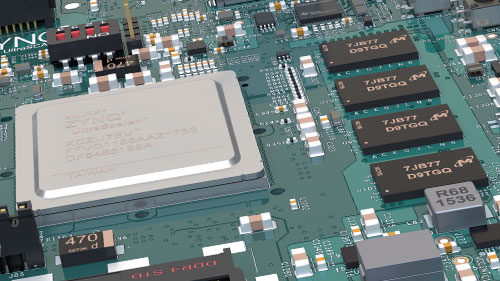
On boards built around CPUs, GPUs, FPGAs, and SoCs, the challenge is compounded by device packaging such as dense BGAs and fine‑pitch components, together with buried PCB interconnects that are inaccessible to traditional probe-based testing. Critical connections disappear beneath packages and into inner layers, leaving teams unsure whether they are dealing with a hardware fault or a software issue.
Without a structural test method, uncertainty dominates and uncertainty is what turns bring-up delays into schedule risk.
The Turning Point
Boundary scan breaks this cycle by validating hardware connectivity before software is functional.
By using the JTAG interface already present on CPUs, GPUs, FPGAs, and SoCs, engineers can verify interconnects, device-to-device links, and assembly integrity without relying on firmware or extensive probing.
With boundary scan in place, teams can:
- Eliminate hardware uncertainty early
- Separate electrical issues from firmware problems
- Focus debugging effort where it actually belongs
- Avoid unnecessary rework and board swaps
Bring-up shifts from guesswork to structured validation.
Why It Works
Functional testing is designed to exercise behaviour, not to prove physical connectivity. During bring-up, that distinction is critical.
Relying solely on functional tests introduces two major risks:
- Hidden connectivity faults – Cold solder joints, marginal opens, and partial connections can appear to function correctly once software is running. These issues often resurface later as intermittent failures, costing weeks of investigation.
- Poor fault insight – When functional tests fail, they rarely indicate where the fault is located. Engineers lose time instrumenting software or probing blindly, slowing progress even further.
Boundary scan addresses these gaps by validating static connectivity directly, at low speed, before software or high-speed signalling can obscure underlying problems.
Key advantages:
- Immediate clarity on whether the hardware is fundamentally sound
- Deterministic diagnostics that identify what failed and where
- Earlier fault isolation, when fixes are fastest and least disruptive
- Reusable test assets that carry forward into later stages
Rather than replacing functional testing, boundary scan establishes a solid hardware foundation that makes software debug more efficient.
Results
Teams that use boundary scan during board bring-up consistently report:
- Weeks saved during initial bring-up, not just days
- Faster differentiation between hardware and software issues
- Fewer unnecessary board spins and rework cycles
- Smoother transitions from evaluation to prototype
- Greater confidence moving designs toward production
When boundary scan tests are already proven on a vendor’s development board, those same tests can migrate directly onto the customer’s prototype, further accelerating progress and reducing risk.
Take the Next Step
- See how boundary-scan testing shortens board bring-up and keeps projects on schedule.
- Explore more than 100 real-world success stories. Check out 100+ case studies.
- Learn how early hardware visibility can prevent bring-up delays on your next design. Try boundary-scan on your own board for free.
Related Reading