Introduction to JTAG
Introduction
JTAG is a technology which is in its third decade as an industry standard. However, its potential as a testing and programming tool is only just beginning to be fully realised.
Applications
Connection testing and In System Programming (ISP) are the two applications most commonly associated with JTAG. However the technology has far more to offer.
Non-JTAG-compliant sections of a circuit can be tested by using the interconnecting nets between the devices in the JTAG chain and other devices in the circuit.
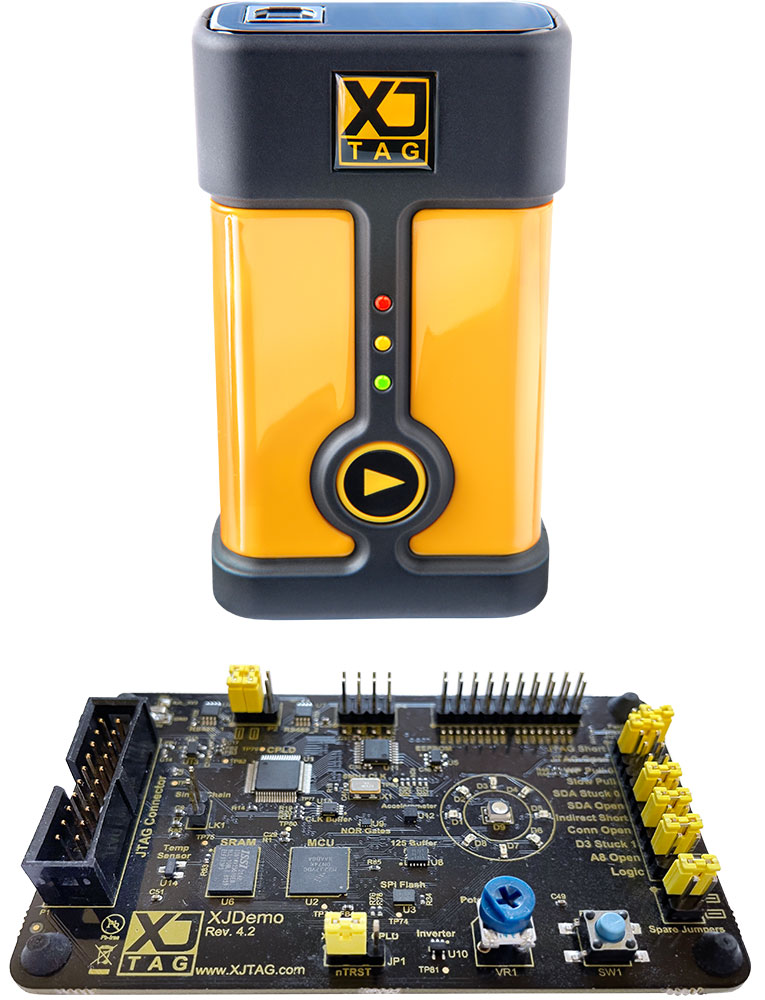
XJTAG has been designed to unlock the potential of JTAG, with its development system of software products and JTAG controller hardware (available with a range of connectivity options).
History of JTAG
Advances in silicon design such as increasing device density and, more recently, BGA packaging have reduced the efficacy of traditional testing methods.
In order to overcome these problems, some of the world’s leading silicon manufacturers combined to form the Joint Test Action Group. The findings and recommendations of this group were used as the basis for the Institute of Electrical and Electronic Engineers (IEEE) standard 1149.1: Standard Test Access Port and Boundary Scan Architecture. This standard has retained its link to the group and is commonly known by the acronym JTAG.
Using JTAG
For a device to be JTAG compliant, it must have an associated BSDL file which describes the implementation of JTAG in that device.
A platform-independent way of representing test sequences to be sent through the JTAG chain is SVF.
On this page
And how can I make use of it?
What is JTAG and how can I make use of it? High-Level Guide to JTAGSee what JTAG can do
High-level Guide to JTAG Technical Guide to JTAGA low-level look at how JTAG is implemented
Technical Guide to JTAG JTAG Testing with XJTAGXJTAG extends the possibilities of JTAG
JTAG Testing with XJTAG Design for Testability (DFT) GuidelinesSuggestions for improving PCB testability
Design for Test (DFT) Guidelines
Configure your products